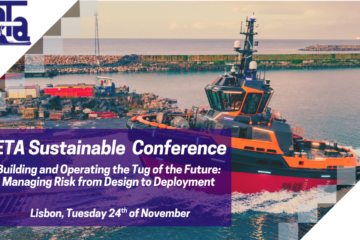
The European Tugowners Association held its 2026 Sustainable Conference in Lisbon on the 24th of November, bringing together representatives from across the maritime industry to discuss the challenges of building and operating the tug of the future.
Under the theme “Building and Operating the Tug of the Future: Managing Risk from Design to Deployment”, this year’s conference focused on the growing range of risks facing the towage sector and the need to address them throughout a vessel’s lifecycle, from initial design and construction to deployment and day-to-day operations.
The conference took place against a backdrop of deteriorating geopolitical conditions and growing threats to maritime security. Recent attacks on commercial shipping in the Black Sea, the Gulf of Finland and the Mediterranean have further highlighted the vulnerability of maritime operations to the spillover of international conflicts.
In his opening remarks, ETA Chairman Arjen van Dijk highlighted how the risk landscape facing the towage industry is evolving and why the sector’s role extends well beyond the provision of commercial services. As he emphasised: “For tugowners, risk is certainly nothing new. Our vessels operate where precision, reliability and safety matter every single day. But the environment in which we operate is becoming considerably more complex. At the same time, the geopolitical environment is reminding us of another reality. Towage and salvage services are not only commercial services. In difficult circumstances, they become essential maritime capabilities. They protect ships, ports, infrastructure and, ultimately, the continuity of maritime trade.”
His remarks set the scene for a morning of presentations and discussions examining how the industry can anticipate, manage and mitigate risks in an increasingly challenging operating environment.
The morning opened with presentations from Ben Harris (Shipowners´ Club), who examined the challenges arising from sanctions and the risks of operating in war zones, and James Herbert (International Salvage Union), who addressed the particular difficulties and risks faced by salvors when undertaking operations in areas affected by conflict.
The conference then moved to a panel discussion bringing together perspectives from different parts of the maritime value chain.
Mijndert Wieseneker, from Damen, explored how the current geopolitical climate is changing the operating environment for shipbuilders, the additional considerations that must now be taken into account when developing new vessels, and how shipyards are managing delays, uncertainty and increased project risks.
Aileen Van Raemdonck, EMPA Secretary General brought the perspective of maritime pilots, discussing the specific risks they face in today’s operating environment and the measures being taken by the pilotage sectorto mitigate them.
Finally, Marc Overheul from Overheul Marine addressed the challenges associated with new-build projects in an increasingly uncertain world, examining the additional risks and considerations that owners and other stakeholders must take into account when planning and delivering new vessels.
Across the presentations and discussions, a common message emerged: the tug of the future must be designed not only for performance, efficiency and sustainability, but also for resilience. Geopolitical instability, sanctions, cybersecurity threats, supply-chain disruptions, insurance considerations and evolving operational risks are increasingly interconnected and require a more comprehensive approach to risk management.
ETA would like to thank all speakers and participants for their valuable contributions and for making this year’s conference another constructive opportunity for discussion and exchange.
You can download the presentations by clicking on the names of the speakers.